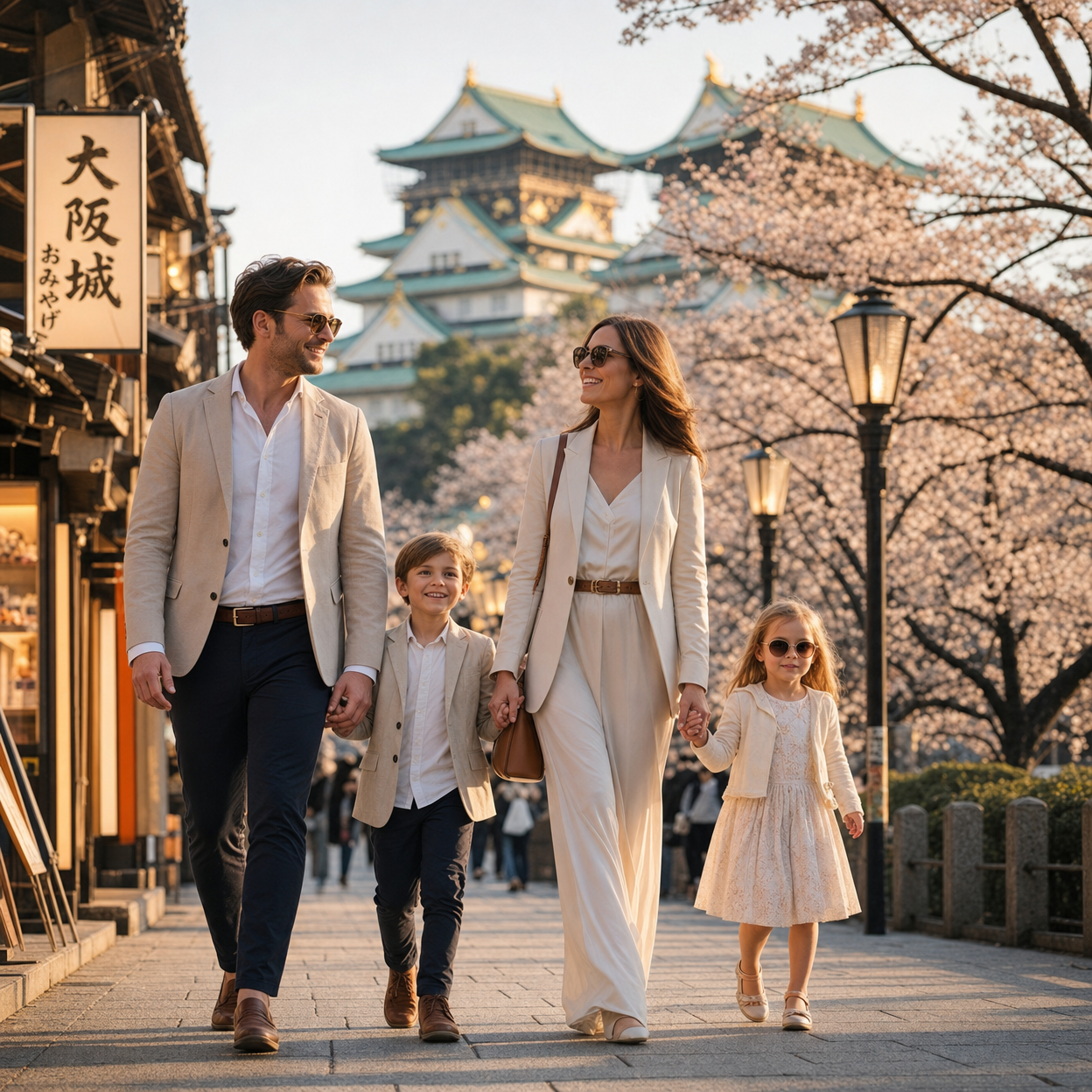
The 2026 Insider's Guide to Expat Family Health Insurance in Osaka
What HR didn't tell you. What the cheap plans don't cover. And how to get it right before you need it.
Osaka is one of the most liveable cities in Asia. Exceptional food, genuine safety, world-class infrastructure, and a pace of life that Tokyo expats quietly envy. You made a good call.
What your company's HR team glossed over is that Japan's healthcare system, genuinely excellent by global standards, was built for Japanese nationals. And navigating it as a foreign-language speaker, without the right cover, is an experience that will test your credit card, your patience, and your composure at the worst possible moment.
This is not a scare piece. It's a briefing. Read it once, make one decision, move on.
The Healthcare Reality Nobody Puts in the Welcome Pack
Osaka has excellent private medical facilities. Osaka Red Cross Hospital in Tennoji. Yodogawa Christian Hospital in Higashiyodogawa. Kansai Medical University Hospital in Hirakata. These are genuinely world-class facilities with international patient departments.
But "world-class" and "affordable without the right cover" are two very different things.
A private suite at Osaka Red Cross Hospital runs JPY 50,000 to 150,000 per night. A serious accident, complicated pregnancy, or cardiac event can generate a bill exceeding JPY 3,000,000 before you've left the building. A single ICU stay can exceed $50,000 to $100,000 USD. That's before specialist fees, diagnostics, and post-discharge care.
Japan's National Health Insurance (NHI) covers 70% of standard costs for enrolled residents, but it does not cover private room supplements, international patient coordination fees, or the specialist clinics that expat families actually use. Foreigners are not covered by NHI for private luxury wards.
The "False Sense of Security" That Catches Expat Families Off Guard
Most corporate expats arrive in Osaka with a group health policy arranged by their employer. It feels like a solved problem. HR handled it. There's a card in your wallet.
Here is what that card often does not cover:
"My HMO won't cover anything outside Japan." Employer-tied plans are Japan-only. The moment you travel for work, visit family abroad, or need specialist care in Singapore or Bangkok, you're on your own.
"I got reassigned out of Osaka and lost my coverage overnight." Employer-tied plans evaporate the day your contract ends or your assignment changes. No grace period. No portability. No continuity of care for ongoing conditions.
"The local public hospital was a war zone, I'd never take my kids there." Public facilities are excellent for emergencies but not designed for the international patient experience. Language barriers, long waits, and limited English-speaking specialists are the reality.
The false sense of security is this: you assume you're covered because you have a card. You find out you're not when you're standing at a hospital admissions desk at 11pm with a sick child, and nobody speaks English.
Which international schools do most expat families in Osaka choose?
The two main options are Osaka International School of Kwansei Gakuin (OIS) in Minoh and Kansai International Academy (KIA) in Osaka City. Most expat families cluster in Minoh, Suita, and Central Osaka.
Premium paediatric care is available at Osaka Red Cross Hospital (Tennoji) and Yodogawa Christian Hospital (Higashiyodogawa), both within 20 to 40 minutes of the main school gates. A GP visit at an international clinic in Umeda or Namba runs ¥8,000 to ¥15,000. A paediatric specialist starts at ¥15,000 to ¥30,000 per consultation, before tests.
Your children need a plan with genuine outpatient cover, direct billing at these facilities, and no sub-limits on paediatric care. A plan that covers hospitalisation but leaves specialist visits as out-of-pocket expenses is not a family plan. It's a gap.
Should I see a GP first or go straight to a specialist in Osaka?
Most expats skip the local GP gatekeeper and go directly to international-standard outpatient departments at Osaka Red Cross Hospital or Kansai Medical University Hospital. Japan's system technically encourages GP referrals, but international patient departments at the major private hospitals accept direct bookings.
Which hospitals in Osaka take direct billing from global insurers?
The main facilities with established direct billing relationships are:
Insurers with confirmed direct billing at these facilities include: Bupa Global, Cigna, Allianz Care, AXA Global, MSH, GeoBlue, Aetna International, and Generali. Always confirm your specific plan's network before admission.
How does private healthcare in Osaka compare to the UK, Australia, or the US?
Top private hospitals in Osaka match Western standards on hotel-style facilities and English-fluent international patient staff. For routine care, specialist consultations, and planned procedures, the quality is excellent.
The gap shows up in complex, high-acuity cases. Advanced oncology, cardiac surgery, complex neurosurgery, and transplants, most expats still travel to Tokyo, Singapore, or Bangkok for those. Your plan needs to cover that evacuation.
What are the biggest local health risks for expats in Osaka?
Osaka's main health risks for expats are: severe summer heatstroke (July to September temperatures regularly exceed 35°C with high humidity), intense seasonal allergies (cedar pollen season February to April is debilitating for many expats), and seismic risk requiring emergency trauma care. Japan sits on the Pacific Ring of Fire, Osaka's last major earthquake was 2018, and preparedness matters.
Your plan needs to cover vector-borne disease, trauma, and respiratory care, and critically, medical evacuation for complex cases that exceed Osaka's local specialist capacity.
The Portability Trap: Why Local Cover Is the Single Biggest Mistake
The three phrases we hear most often from expats who've been burned:
"My company switched HMOs and now my wife's pregnancy isn't covered."
"I got laid off in Osaka and my visa is on a 60-day countdown, what about my kid's asthma?"
"My NHI won't cover us when we go home for the summer."
Relying 100% on Japanese NHI, a local corporate plan, or employer-tied cover is the single biggest mistake expat families make. These plans are Japan-only, employer-dependent, and terminate the moment your circumstances change.
A globally portable IPMI policy, Bupa Global, Cigna Global, Allianz Care, AXA Global, MSH, William Russell, follows you anywhere. Osaka today. Singapore next year. London after that. Your cover doesn't care about your employment status or your visa category.
Regional Medical Evacuation: The Cost Nobody Plans For
For complex cases, cardiac, oncology, advanced neurosurgery, complex paediatrics, expats are routinely evacuated from Osaka to Tokyo's tier-1 international facilities, or Medevac'd back to their home country (US, UK, Australia) for complex long-term care.
A Medevac jet from Osaka typically involves a 3 to 4 hour flight with a specialist medical team. The cost: $80,000 to $250,000+ USD. Cheap policies and local HMOs do not cover this. Full stop.
Local Plan vs. Premium Portable Cover: The Comparison
| Feature | Japanese NHI / Local Plan | Premium Portable IPMI |
|---|---|---|
| Global Portability | ❌ Japan only | ✅ Worldwide |
| Medical Evacuation | ❌ Not covered | ✅ $80k to $250k+ covered |
| Dependants Cover | ⚠️ Sub-limits common | ✅ Full family cover |
| Pre-existing Conditions | ❌ Excluded or limited | ✅ Underwritten at application |
| Claims Advocacy | ❌ None | ✅ Broker fights for you |
| Direct Billing at Osaka Red Cross | ⚠️ Limited | ✅ Confirmed network |
| Continues if you change jobs | ❌ Terminates immediately | ✅ Fully portable |
| Covers home country visits | ❌ No | ✅ Yes |
We're an Independent Broker. Not an Insurer. Not a Comparison Website.
EHG is a specialist independent broker. We work exclusively with internationally mobile clients, executives, families, and mobile professionals who need cross-border coverage that actually works.
We audit the top global insurers, compare them against your specific profile, and recommend the plan that fits, not the plan with the highest commission. Our fee is paid by the insurer. Using EHG costs you exactly the same as buying direct, except you get independent advice and someone in your corner at claims time.
We compare Cigna, Allianz Care, AXA, Bupa Global, and others against your specific profile, age, family size, pre-existing conditions, budget, Osaka-specific requirements.
Our fee is paid by the insurer. Using EHG costs exactly the same as buying direct, except you get independent advice, a market comparison, and someone in your corner at claims time.
When you need to make a claim at 11pm at Osaka Red Cross Hospital, we are your point of contact. Not a call centre. Not a chatbot.
Everything You Need to Know Before You Buy
IPMI stands for International Private Medical Insurance. Unlike local Japanese health plans or employer group policies, IPMI is globally portable, it covers you in Osaka, on holiday in Europe, visiting family in Australia, and on a business trip to the US. For expat families who move countries every few years, IPMI is the only product that provides genuine continuity of cover.
Premiums depend on age, family size, area of cover, and deductible. A healthy individual aged 35 with a $1,000 deductible and worldwide cover (excluding US) typically pays $150 to $350/month. A family of four in the same bracket pays $400 to $900/month. Older applicants or those with pre-existing conditions pay more. See the pricing guide below for indicative ranges.
A deductible (also called an excess) is the amount you pay out-of-pocket before your insurer covers the rest. A $0 deductible gives you maximum coverage with the highest premium. A $1,000 or $2,500 deductible significantly reduces your annual premium, often by 20 to 40%. For healthy families who want catastrophic cover, a higher deductible is usually the right call.
It depends on the insurer and the condition. Most IPMI insurers underwrite at application, they review your medical history and either cover the condition, exclude it, or apply a loading (higher premium). Conditions that are well-controlled and stable are often covered with a loading. Conditions that are active or complex may be excluded. The key is to disclose everything accurately at application, non-disclosure is the most common reason claims are denied.
Inpatient-only cover pays for hospital admissions, surgery, and overnight stays. It does not cover GP visits, specialist consultations, diagnostics, or prescriptions unless you're admitted. Inpatient + outpatient cover adds all of those. For families with children, who generate significant outpatient costs through GP visits, paediatric specialists, and vaccinations, inpatient + outpatient cover is almost always worth the additional premium.
Run a Free Comparison and Find Out:
The #1 mistake expat families make when choosing cover in Osaka, and how it costs them tens of thousands of USD at the worst possible moment.
How to guarantee global portability so you are never trapped by your employer's HR policy or a Japanese NHI plan when your assignment ends.
How to get front-of-the-line cashless access to Osaka Red Cross Hospital and Yodogawa Christian Hospital without paying a single yen out of pocket.
The hidden exclusions in Japanese NHI and local co-pay plans that leave dependants dangerously unprotected.
Why buying direct from the insurer leaves you fighting claims alone, and how having EHG as your broker changes the outcome when a claim gets complicated.
2026 Expat Health Insurance Pricing Guide, Osaka
All figures in USD per month. Assumes ~$1,000 to $1,500 deductible, worldwide cover excluding US. Actual premiums depend on age, health history, and selected plan. Use the quote engine below for a personalised comparison.
| Profile | Entry Cover | Mid-Range | Premium |
|---|---|---|---|
| Individual (30 to 39) | $120 to $180/mo | $200 to $320/mo | $380 to $550/mo |
| Couple (30 to 39) | $230 to $340/mo | $380 to $580/mo | $700 to $980/mo |
| Family (2 adults + 2 kids) | $380 to $560/mo | $620 to $900/mo | $1,100 to $1,600/mo |
| Individual (50 to 59) | $280 to $420/mo | $480 to $680/mo | $800 to $1,200/mo |
* Indicative ranges only. Entry = IP-only base plans. Mid = IP+OP enhanced. Premium = comprehensive worldwide plans with dental/maternity options. Deductible $1,000 to $1,500. Excludes US cover. Use the comparison tool below for exact pricing.
Questions Osaka Expats Ask Us Every Week
No. Employer-tied plans terminate the day your contract ends. A globally portable IPMI policy (Bupa Global, Cigna Global, Allianz Care) follows you regardless of employer, visa status, or country. This is the single most important reason to own your own plan.
Yes, Bupa Global, Cigna, Allianz Care, AXA Global, MSH, GeoBlue, Aetna International, and Generali all have direct billing relationships with these facilities. You walk in, show your card, and the hospital bills your insurer directly. No upfront payment, no claims forms.
Yes, all premium IPMI plans include medical evacuation to the nearest appropriate facility or to your home country. A Medevac jet from Osaka to Singapore or Tokyo costs $80,000 to $250,000+. Cheap policies and local HMOs do not cover this.
Enrolled residents can access Japan's National Health Insurance (NHI), which covers 70% of standard costs. However, NHI does not cover private room supplements, international patient coordination fees, or the specialist clinics expat families actually use. It also provides zero cover outside Japan.
A globally portable IPMI plan with full outpatient cover (GP + specialist + diagnostics), direct billing at Osaka Red Cross Hospital and Yodogawa Christian Hospital, and medical evacuation. Cigna Global, Allianz Care Enhanced, and Bupa Global are consistently strong performers for families. Run the comparison below for your specific profile.
Get Your Personalised Comparison, Free, No Obligation
In 60 seconds, you'll see the top 3 international health insurance plans tailored to your specific family setup in Osaka. No sales calls unless you want one. No personal details required to see your options.
100% Free. Zero Obligation.
Our fee is paid by the insurer. Using EHG costs you exactly the same as buying direct, except you get an independent expert in your corner.
Expat Health Group is an independent insurance broker. We compare plans from leading international insurers including Cigna Global, Allianz Care, AXA, and Bupa Global. All comparisons are indicative and subject to underwriting. Information on this page is accurate to the best of our knowledge as of May 2026.