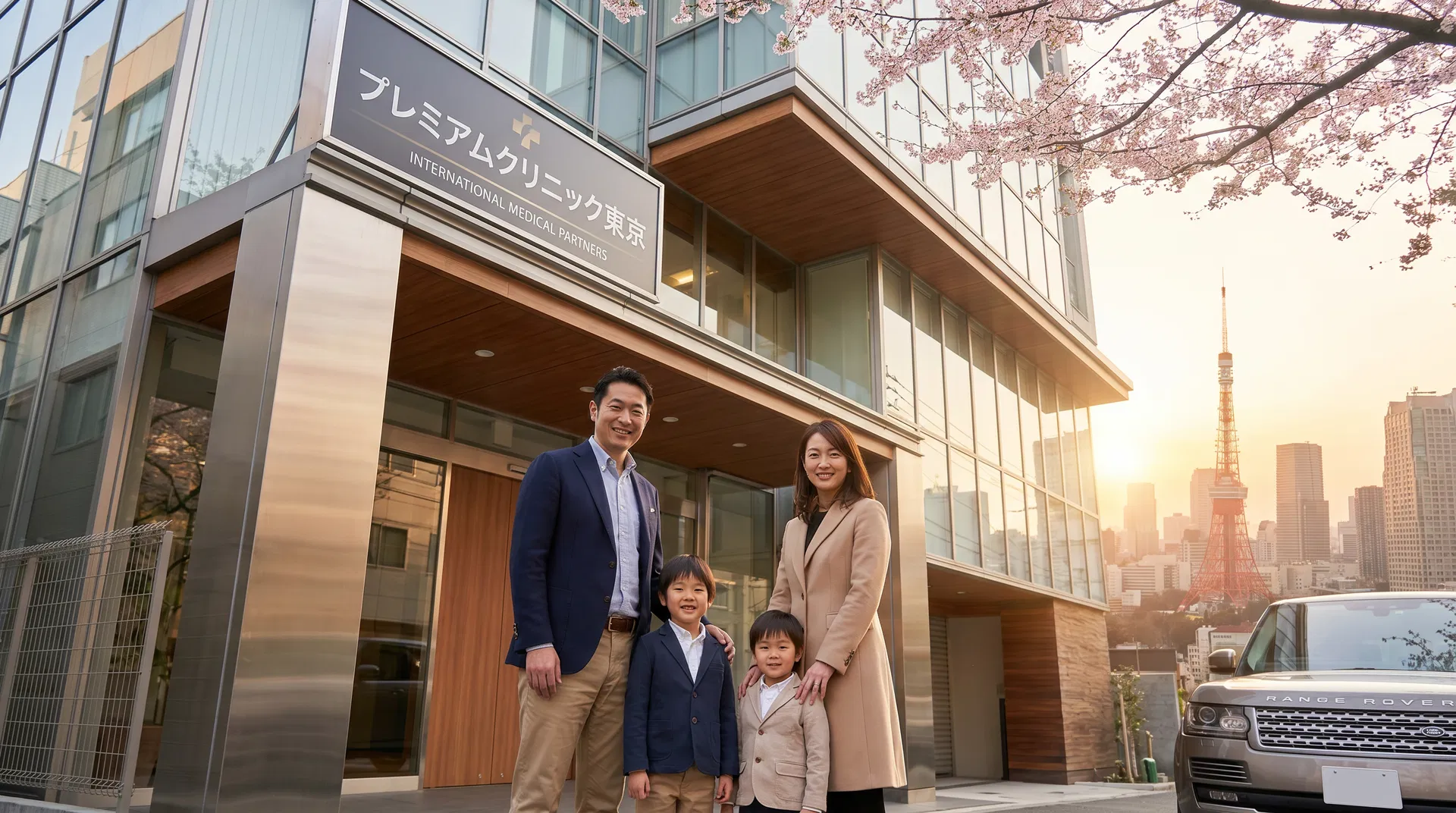
The 2026 Insider's Guide to Expat Family Health Insurance in Tokyo
What HR didn't tell you. What the cheap plans don't cover. And how to get it right before you need it.
You chose Tokyo for the career. The culture. The safety. The extraordinary quality of life that makes it consistently one of the world's most liveable cities.
What HR glossed over in your relocation package is that Japan's healthcare system, world-class by any measure, was designed for Japanese nationals. And navigating it as a foreign-language speaker, without the right cover, is an experience that will test your patience, your credit card, and your composure simultaneously.
This is not a scare piece. It's a briefing. Read it once, make one decision, move on.
The Dark Side of Tokyo Healthcare Nobody Puts in the Welcome Pack
Japan has exceptional medical infrastructure. St. Luke's International Hospital in Tsukiji. Tokyo Medical and Surgical Clinic in Moto-Azabu. Hiroo Hospital. These are genuinely world-class facilities with English-speaking staff and international patient departments.
But "world-class" and "affordable without the right cover" are two very different things.
A single night in a private room at St. Luke's can run ¥50,000 to ¥120,000. A complicated birth, a cardiac event, or a serious accident can generate a bill exceeding ¥3,000,000 before you've left the building. That's before specialist fees, diagnostics, and post-discharge care.
Japan's national health insurance (Kokumin Kenko Hoken) covers 70% of costs for enrolled residents, but it does not cover the private room supplements, international patient coordination fees, or the specialist clinics that expat families actually use. The gap between what the system covers and what you actually pay is where families get hurt.
You need private international cover. The question is whether the cover you have is actually adequate, or whether you're carrying a false sense of security in your wallet.
The "False Sense of Security" That Catches Expat Families Off Guard
Most corporate expats arrive in Tokyo with a group health policy arranged by their employer. It feels like a solved problem. HR handled it. There's a card in your wallet.
Here is what that card often does not cover:
International patient coordination fees. The premium English-language clinics in Tokyo charge a coordination fee on top of the medical cost. Many employer group policies treat this as an administrative expense and exclude it entirely.
Pre-existing conditions for dependants. Your employer's policy covers you. The fine print on your spouse and children's coverage is often far weaker, with sub-limits, exclusions, and waiting periods that only become visible when you need to claim.
Annual limits that look generous until they aren't. A serious illness, cancer, a complicated pregnancy, a major accident, can exhaust a ¥10,000,000 annual limit faster than you expect. Many standard employer policies in Japan sit at exactly that number.
The false sense of security is this: you assume you're covered because you have a card. You find out you're not when you're standing at a hospital admissions desk at 11pm with a sick child, and nobody speaks English.
What Makes Tokyo Different
Raising a Family Near ASIJ or the British School in Tokyo
If your children attend The American School in Japan (ASIJ) in Chofu or The British School in Tokyo (BST) in Shinjuku, you're living in one of the most concentrated expat family communities in Asia. These are communities where parents talk, and what they talk about, quietly, after the school run, is the bill they got last month that their insurance didn't cover.
Premium paediatric care in Tokyo is excellent, but it is not cheap. A GP visit at an international clinic in Hiroo or Azabu runs ¥8,000 to ¥15,000. A paediatric specialist at St. Luke's or Tokyo Medical and Surgical Clinic starts at ¥15,000 to ¥30,000 per consultation, before any tests.
Your children need a plan with genuine outpatient cover, direct billing at the top international facilities, and no sub-limits on paediatric care. A plan that covers hospitalisation but leaves your kids' specialist visits as out-of-pocket expenses is not a family plan. It's a gap.
The Direct Billing Requirement
Expat families should not be floating five-figure medical bills on a credit card while waiting for reimbursement.
Direct billing means the hospital bills your insurer directly. You walk in, show your card, receive treatment, and walk out. No upfront payment. No claims forms. No waiting 30 to 60 days for a reimbursement that may come back short.
St. Luke's International Hospital and Tokyo Medical and Surgical Clinic both offer direct billing, but only with specific international insurers. Not every plan on the market has a direct billing arrangement with these facilities. If yours doesn't, you are paying upfront and hoping the reimbursement arrives in full.
The Language Barrier and Kafunsho Reality
Japan has one of the lowest English proficiency rates among developed nations. Outside the handful of international clinics in central Tokyo, most hospitals operate entirely in Japanese. In a non-emergency situation, this is manageable. In a genuine emergency, a child with a high fever at 2am, a serious accident, a sudden cardiac event, it is not.
The right international health plan includes 24/7 English-language medical assistance lines and direct relationships with Tokyo's international patient departments. This is not a luxury. It is the difference between a managed situation and a crisis.
Beyond emergencies: seasonal cedar pollen allergies (Kafunsho) affect an estimated 30 to 40% of Japan's population and hit expat families particularly hard, especially children who haven't built up any tolerance. Severe, untreated Kafunsho can escalate into chronic rhinitis, asthma, and persistent respiratory issues requiring specialist care. Many standard employer policies treat allergy management as a routine outpatient expense with low sub-limits. If your child needs an allergist, immunotherapy, or specialist respiratory care, you need a plan that covers it properly.
What Corporate Expats in Tokyo Get Wrong
The "Golden Handcuffs", The Portability Problem
The biggest mistake corporate expats make in Tokyo is relying 100% on their employer's health policy and assuming the problem is solved.
Here is what happens when that assumption breaks: you change jobs. Your contract ends. You go independent. You relocate. On your last day of employment, that policy disappears.
Worse: if a family member developed a serious condition while covered under your employer's plan, a cancer diagnosis, a chronic illness, a significant injury, they are now virtually uninsurable on the open market. Every insurer will either exclude that condition entirely or decline to cover them at all.
The solution is to own a private, globally portable policy that you control, independent of your employer, independent of your location, and independent of your employment status. This is the executive safety net. It travels with you to Tokyo, back home, and to wherever the next posting takes you.
Regional Medical Evacuation
Tokyo's international hospitals are excellent for most situations. But for a catastrophic accident, a complex surgical case, or a serious oncology diagnosis, the right call may be a medevac to Singapore's Mount Elizabeth or direct repatriation home.
A medical evacuation flight from Tokyo to Singapore costs USD 15,000 to 40,000. Repatriation to the UK, US, or Australia is significantly more.
Most cheap or local policies don't cover this. The ones that do often have sub-limits that don't come close to the actual cost. A genuine international health plan includes full medical evacuation and repatriation cover with no sub-limit.
The rule of thumb: if your health policy was arranged by HR and you've never read the full policy document, you almost certainly have gaps you're not aware of.
Why Expat Families in Tokyo Use EHG
Expat Health Group is not an insurance company. We are an independent broker, which means we work for you, not for the insurer.
Our job is to audit the top global insurers (Cigna, Allianz Care, AXA, Bupa Global, and others), compare them against your specific profile, your age, your family size, your pre-existing conditions, your budget, your Tokyo-specific requirements, and recommend the plan that actually fits. Not the plan with the highest commission. The plan that fits.
We compare Cigna, Allianz Care, AXA, Bupa Global, and others against your specific profile, age, family size, pre-existing conditions, budget.
Our fee is paid by the insurer, not by you. Using EHG costs exactly the same as buying direct, except you get independent advice, a comparison across the market, and someone in your corner at claims time.
When you need to make a claim at 11pm at St. Luke's, we are your point of contact. Not a call centre. Not a chatbot.
We strip out the unnecessary riders and add-ons that inflate premiums without adding real value for your situation. We make sure your plan has direct billing at St. Luke's and Tokyo Medical and Surgical Clinic. And if a claim gets complicated, if the insurer pushes back, delays, or tries to apply an exclusion you weren't told about, we fight that battle for you.
Run a Free Comparison and Find Out:
The #1 mistake expat families make when choosing cover in Tokyo, and why it costs them thousands at the worst possible moment.
How to guarantee global portability so you are never trapped by your employer's HR policy if you change jobs, go independent, or relocate.
How to get cashless, front-of-the-line access to St. Luke's International Hospital without paying a single yen out of pocket.
The hidden clauses in local employer policies that leave your spouse and children with far weaker protection than you realise.
Why buying direct from the insurer leaves you fighting claims alone, and how having EHG as your broker changes the outcome when a claim gets complicated.
Get Your Personalised Comparison, Free, No Obligation
In 60 seconds, you'll see the top 3 international health insurance plans tailored to your specific family setup in Tokyo. No sales calls unless you want one. No personal details required to see your options.
100% Free. Zero Obligation.
Our fee is paid by the insurer. Using EHG costs you exactly the same as buying direct, except you get an independent expert in your corner.
Expat Health Group is an independent insurance broker. We compare plans from leading international insurers including Cigna Global, Allianz Care, AXA, and Bupa Global. All comparisons are indicative and subject to underwriting. Information on this page is accurate to the best of our knowledge as of May 2026.